


















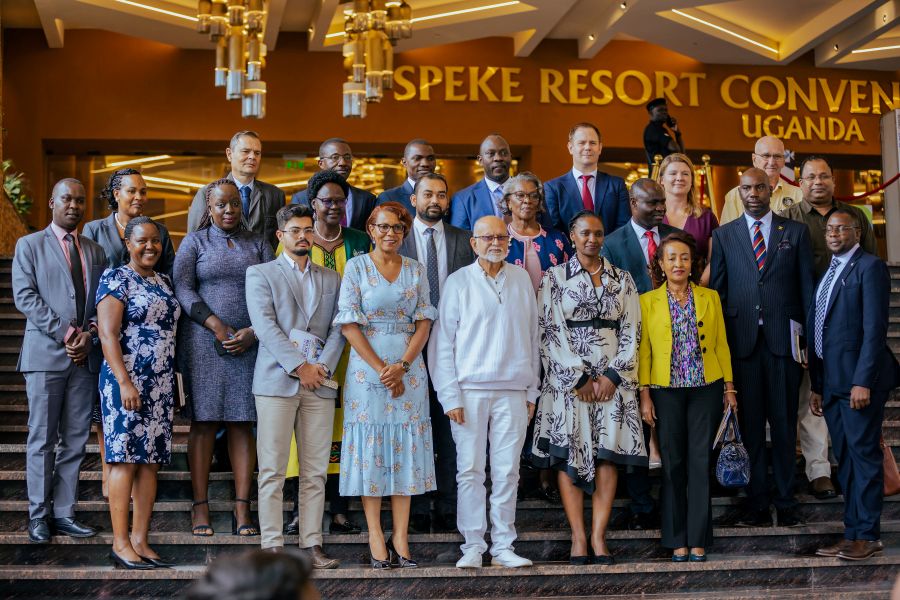
The Ministry of Tourism, Wildlife and Antiquities (MTWA), in partnership with the Presidential CEO Forum (PCF), has convened the first-ever Top Tourism Investment Round Table at Speke Resort Munyonyo.
The high-level engagement brought together 35 key stakeholders, including policymakers, CEOs, investors, development partners, and private sector leaders, to chart a new course for positioning Uganda as a premier tourism and investment destination.
The round table generated strong feedback on how the government can more effectively complement the private sector in unlocking Uganda’s tourism potential. Discussions focused on infrastructure development, conservation, harmonized tax policies, product diversification, marketing, and enhancing tourist safety.
Participants underscored the importance of improving road networks, air connectivity, and utilities to open up tourism sites and reduce barriers to investment. They also highlighted the need for stronger community participation in conservation and sustainable practices to preserve Uganda’s rich biodiversity while improving livelihoods.
Speaking on behalf of the State Minister for Tourism, Wildlife and Antiquities, the Director of Tourism, Dr. Basil Ajer, emphasized the urgent need to activate the entire tourism value chain if Uganda is to position itself competitively. He noted that Uganda’s return on investment in tourism averages 14 percent, while return on equity ranges between 20 and 25 percent, making the sector one of the most viable for economic growth. He pledged to convene an inter-ministerial meeting to harmonize solutions, adding that resolutions from the dialogue would be escalated to the Office of the Prime Minister.
The Executive Director of the National Planning Authority, Dr. Joseph Muvawala, described the current moment as a turning point for Uganda’s economy and tourism. He highlighted fiscal constraints, pointing out that although Uganda’s national budget stands at UGX 72 trillion, only UGX 32 trillion is collected domestically, with the rest financed through borrowing. “We have invested in fundamentals, but the fiscal space remains tight—less than UGX 20 trillion is available for development. To change course, the economy must multiply three times in the next five years, growing at about 10 percent annually,” he said.
Dr. Muvawala challenged the private sector to take the lead in this transformation by scaling tourism tenfold in the next 15 years. “We cannot continue doing business the same way. This sector must become more private-sector driven. The decisions we make in forums like this one will run the country,” he added.
Private sector players raised concerns about inaccurate tourism data, underfunded marketing, poor infrastructure, bureaucratic bottlenecks, weak crisis communication, and barriers to investment. They called for reforms in tax regimes, improved road and air connectivity, and more aggressive international branding of Uganda’s “Explore Uganda” campaign.
Uganda’s top tourism investors, including the Marasa Group, Ruparelia Group, Volcanoes Safaris, Satguru Travel and Tourism, and Wildplaces Africa, attended alongside representatives from the Ministry of Tourism, Ministry of Finance, Uganda Tourism Board, Uganda Wildlife Authority, National Planning Authority, and the Uganda Tourism Association.
The round table resolved to establish a Public-Private Tourism Investment Round Table Club to track progress on recommendations, integrate private sector feedback into the upcoming National Development Plan IV (NDPIV), work closely with investors to fast-track tourism infrastructure projects, and expand marketing partnerships with the Uganda Tourism Board, airlines, and international travel platforms.
The discussions in Munyonyo set the stage for the forthcoming 6th Bi-Annual Private Sector Retreat in Fort Portal, where stakeholders are expected to refine actionable commitments to make tourism a leading driver of Uganda’s economic growth.