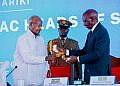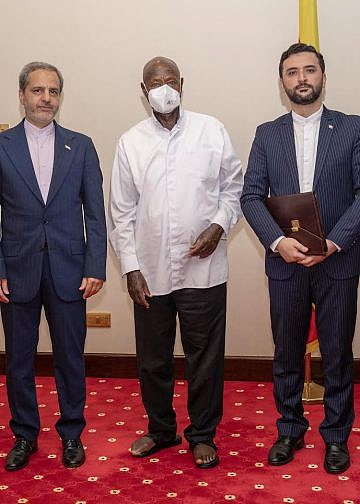









President Museveni has made a resounding call for accelerated East African integration, emphasizing unity as the foundation for regional prosperity, socio-economic transformation, democratic growth, and strategic security.
Speaking at the opening of the inaugural Regional Ministerial Conference on the East African Community Common Higher Education Area (EACCHEA) at Speke Resort, Munyonyo, President Museveni outlined five critical pillars for achieving meaningful integration: economic prosperity, transformation, Pan-Africanism, democracy, and regional security.
“The only way to achieve prosperity is when each family, company, or individual is involved in producing a good or service with ekibaaro (calculation),” Museveni stated. “For that, you need a large, integrated market.”
He called for a reimagined education system aligned with regional development priorities — one that equips citizens to engage productively in a competitive and interconnected East African economy. Stressing that Uganda’s middle-income status cannot be sustained without regional peace, the president noted that global instability demands stronger African cooperation.
“With all that is happening in the world, if you are weak, you cannot survive,” he said. “Economic and political integration — not only in East Africa but across Africa — is vital.”
First Lady and Minister of Education and Sports, Janet Kataaha Museveni, echoed the president’s vision, describing the conference as a pivotal moment for evaluating the EACCHEA’s progress since its launch in 2017.
She challenged regional education leaders to rethink the purpose of higher education — urging institutions to align with community needs, support development initiatives like the Parish Development Model (PDM), and nurture innovation and entrepreneurship at the grassroots level.
“Higher education should no longer be seen as an ivory tower,” she said. “It must become part of the solution to real-life challenges.”
She stressed the need for institutions to produce industry-ready graduates, contribute to community development, and enhance mobility and recognition of qualifications across borders.
With over 300 million people in the East African Community, Janet Museveni noted that the region’s growing population presents both a challenge and an opportunity.
Prof. Mary Okwakol, Executive Director of Uganda’s National Council for Higher Education and Chairperson of the Forum of CEOs of Higher Education Commissions in East Africa, described the conference as a milestone in regional education policy. She called for deeper harmonization of systems, cross-border collaboration in research, and strengthened quality assurance.
“This conference signals a shared commitment to building a coherent, competitive, and trusted higher education system,” said Prof. Okwakol.
Prof. Gaspard Banyankimbona, Executive Secretary of the Inter-University Council for East Africa (IUCEA), reaffirmed support for academic mobility and curriculum harmonization, adding that the mutual recognition of qualifications is essential for the success of the EAC Common Market.
Andrea Ariik, Deputy Secretary-General of the EAC, labeled the conference a “historic moment” and cited key achievements since the 2017 declaration — including the creation of a regional qualifications framework and a quality assurance system. He urged greater investment in digital infrastructure, research funding, and faculty development to address persistent challenges.
The conference concluded with a unified call for stronger partnerships between governments, institutions, and development stakeholders to create an integrated, innovative, and responsive higher education ecosystem in East Africa.
As underscored by President Museveni and other regional leaders, education remains central to the EAC’s transformation agenda — essential for empowering youth, driving innovation, and securing East Africa’s place in the global knowledge economy.