











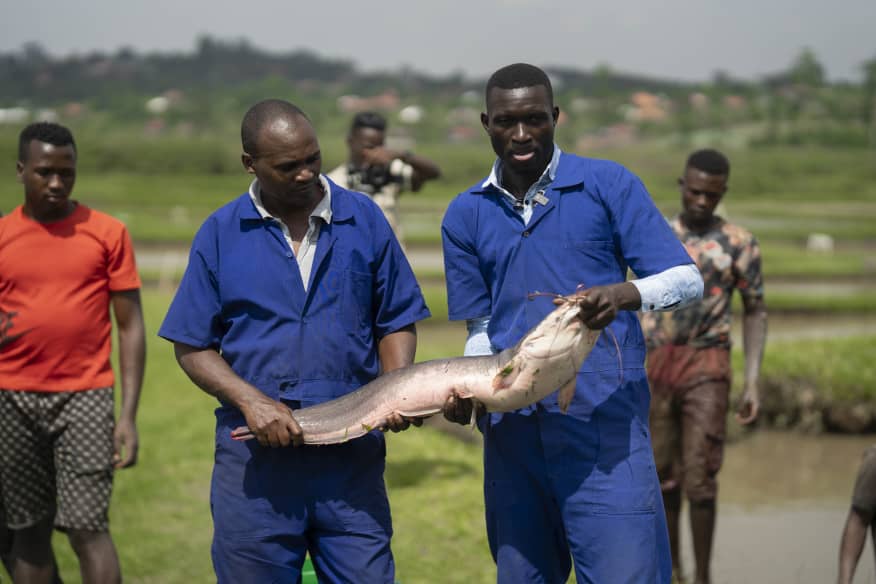
Masheda Foods Limited, a fish farming enterprise has opened a state-of-the-art catfish processing factory in Buyala, Mpigi District.
The 25-acre factory, located 15 kilometers from Kampala along Mityana Road, is the first of its kind in Uganda. With 107 fish ponds and a monthly production capacity of 110 tonnes, the plant integrates hatcheries, training farms, a feed mill, and modern filleting and packaging lines to supply processed catfish products to regional and international markets.
Speaking as chief guest at the launch on Saturday, Ministry of Finance Permanent Secretary Ramathan Ggoobi praised the investment as a model of value addition and a driver of Uganda’s economic transformation.
“Government’s target is to make Uganda a $500 billion economy in the next 15 years. We are focusing on agro-industrialization, tourism, minerals, and science, technology and innovation. Masheda, in my view, is a confluence of all these,” Ggoobi said.
“For the first time we are seeing Ugandan catfish not just being eaten here or exported raw, but value-added and sent as far as the UK, DRC, and Kenya,” he added.
Founder and Proprietor Esther Ann Ampumuza said Masheda’s vision is rooted in building a Ugandan brand that creates jobs, empowers women, and tackles malnutrition.
“Catfish is healthy, rich in protein, low in cholesterol, and full of vitamins. Promoting catfish is about fighting malnutrition, strengthening families, and building a healthy nation,” Ampumuza said.
“Through initiatives like Kembogo Aquaculture Park, where we trained over 300 young people, and Nkore Designs, which empowers women through weaving projects, we’ve shown that when communities are given the right tools, they rise. This factory is a bridge from the pond to the dining tables of Kampala, Nairobi, Kinshasa, and London,” she added.
Managing Director Marvin Lwasa noted that the facility marks the beginning of a much larger ambition.
“The launch signals the real work starting now. We aim to maximize capacity, scale production, and show the youth that agriculture is the future. Our exports to Nairobi, Kinshasa and London are proof that aquaculture can be a profitable and sustainable business if done right,” he said.
However, he pointed out that access to affordable quality fish feed remains the industry’s biggest bottleneck.
“Farmers lose money because feeds are imported, expensive, and inconsistent. If government can support local feed production, aquaculture will flourish and employ thousands more Ugandans,” Lwasa emphasized.
Farmers under the Uganda Catfish Farmer Federation echoed the concern, warning that imported feeds are often ineffective in Uganda’s climate.
“The biggest challenge is feeds. Without good feeds, catfish eat each other. A local fish feed factory would change everything,” said one farmer from Mubende District.
Despite the hurdles, Masheda Foods is positioning itself as a pioneer in Uganda’s aquaculture revolution. The company already exports smoked fillets, burgers, and sausages to over 60 retail outlets in Kinshasa and is expanding into Nairobi and the DRC. Plans are underway to launch on Amazon by late 2025, targeting the Ugandan diaspora in Europe.
Sherinah Ainembabazi Nabakooza, Director at Masheda Foods, said the facility cements the company’s reputation as a premium aquaculture brand.
“With the opening of our new processing facility, Masheda is stepping into a new league of premium aquaculture. We are dedicated to delivering the freshest, highest quality catfish products while setting the standard for excellence in fish processing,” she said.
Masheda Foods sources over 80 percent of its inputs locally, aligning with the Buy Uganda, Build Uganda (BUBU) agenda. Beyond aquaculture, the company runs two key social programs: a youth rehabilitation initiative that has trained more than 500 formerly homeless youths in fish farming, and Nkore Designs, which provides income to over 50 single mothers in Buyala through weaving high-quality reed crafts.
With its holistic model of farming, processing, and social impact, Masheda Foods is turning ponds into profits, empowering farmers and women, and putting Ugandan catfish on the global menu.