








Uganda is set to launch a landmark barter trade agreement with the Republic of Cuba that will see food supplies exchanged for essential medicines and medical equipment.
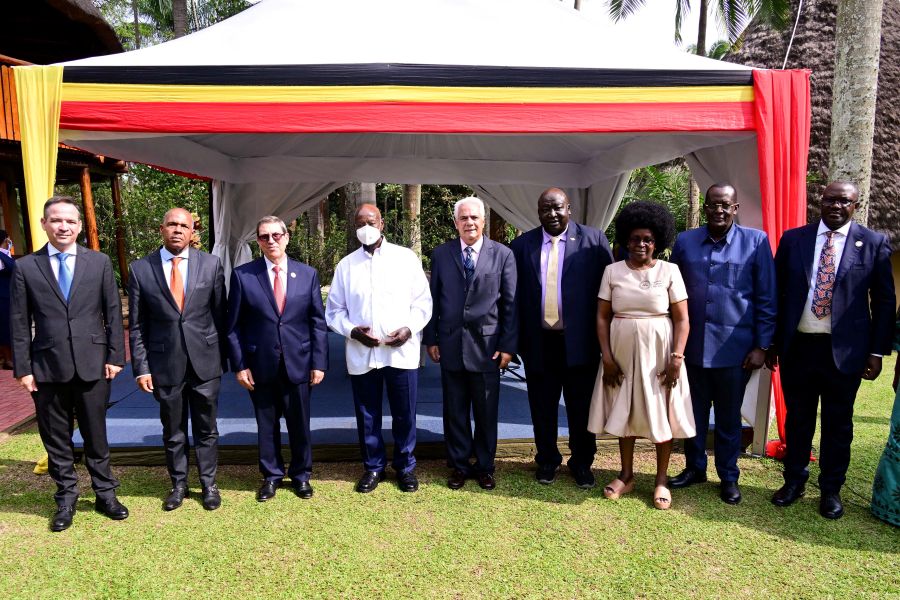
President Museveni made the announcement during a bilateral meeting with a Cuban delegation on the sidelines of the 19th Ministerial Meeting of the Non-Aligned Movement (NAM) held at Speke Resort Munyonyo.
President Museveni confirmed that the initiative is planned to begin in the next financial year, adding that the Ugandan government will prioritize it in its upcoming budget cycle.
“We are ready. We are going to target the next financial year. We are going to start planning, and we shall budget for it,” said Museveni.
The Cuban delegation, led by Foreign Affairs Minister Bruno Rodriguez Parrilla, delivered a message of goodwill from Cuban President Miguel Díaz-Canel and extended an official invitation for Museveni to visit Havana.
The meeting focused on advancing bilateral cooperation in trade, science, technology, and manufacturing, with a specific emphasis on food-for-medicine exchanges.
Under the proposed deal, Uganda would supply food commodities such as maize and beans to Cuba, while receiving pharmaceuticals and medical supplies in return.
The trade initiative will be overseen by the National Enterprise Corporation (NEC) — the commercial wing of the UPDF.
NEC Managing Director Lt. Gen. James Mugira informed the president that preliminary consultations had already taken place to identify Cuba’s specific food needs and the type of medical supplies to be exchanged.
“These supplies will be directed to the Ministry of Health to enhance healthcare delivery and improve the quality of life of Ugandans,” Mugira said.
Also present at the meeting were Monica Musenero, Minister for Science, Technology and Innovation; Vincent Bagiire, Permanent Secretary, Ministry of Foreign Affairs; Juan Humberto Macias Pino, Cuban Ambassador-Designate to Uganda; and Alberto Amoros Nunez, Head of the Cuban Sub-Saharan Africa Division.
The proposed barter arrangement aligns with Uganda’s broader economic strategy of diversifying exports, promoting South-South cooperation, and reducing dependency on foreign aid.
It also complements Cuba’s long-standing efforts to strengthen trade relations with African nations despite enduring economic sanctions.
This development comes as Uganda positions itself as a leader within the Global South, using platforms like NAM to promote economic diplomacy, regional solidarity, and alternative models of international cooperation.