










Uganda has launched a new Artificial Intelligence (AI) Research Cloud aimed at strengthening the country’s capacity to develop homegrown artificial intelligence solutions and support innovators working with large data systems.
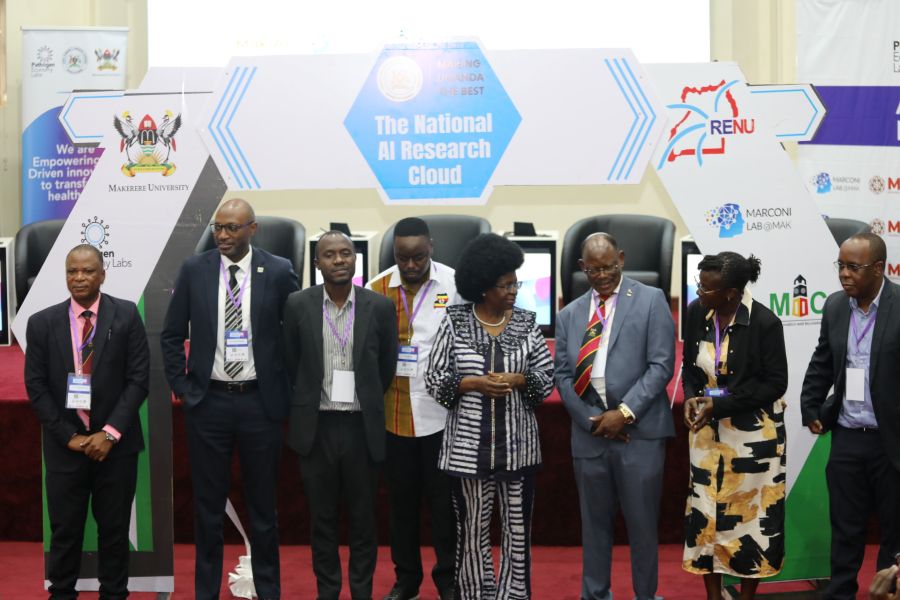
The platform was unveiled at Makerere University during an event that brought together government officials, researchers, university leaders and innovators in the country’s growing technology ecosystem.
Minister for Science, Technology and Innovation Dr Monica Musenero said the initiative is part of government efforts to ensure Uganda actively participates in the global digital transformation driven by artificial intelligence.
Musenero said the government has been investing in innovation infrastructure to support local researchers and entrepreneurs in developing technologies that address national challenges.
She noted that many AI-driven solutions began emerging in Uganda during the COVID-19 pandemic when researchers and innovators started proposing digital tools to support health responses.
“That experience helped us see the potential of artificial intelligence in solving real problems,” Musenero said.
The minister explained that the government subsequently introduced support mechanisms through programmes such as the Presidential Initiative on Epidemics (PRESIDE), which funds health-related innovation.
According to Musenero, several of the projects supported under the programme are now entering the commercialisation stage.
She said government investments in digital infrastructure will continue as Uganda positions itself to take advantage of opportunities presented by the Fourth Industrial Revolution.
“We are creating the infrastructure and the environment where young innovators can develop technologies that create value for the country,” she said.
The AI Research Cloud will provide computing infrastructure and storage capacity for innovators and researchers working with artificial intelligence technologies.
Dr Joyce Nakatumba Nabende, a senior lecturer in the Department of Computer Science at Makerere University and one of the project’s principal investigators, said the platform is designed to address one of the biggest challenges facing AI innovators—access to computing power and data storage.
“When working with artificial intelligence, data is the key ingredient,” Nnakumba said.
She explained that modern AI models, such as large language models, require significant computing resources because they are trained on vast amounts of data.
“With the research cloud, innovators can bring their datasets, store them securely and use powerful machines to develop and train their AI models,” she said.
The platform was developed in partnership with the Research and Education Network for Uganda (RENU), which provides connectivity services to research and education institutions across the country.
The cloud infrastructure will allow researchers to store and process data locally rather than relying on international commercial platforms.
Previously, many developers depended on global technology companies such as Amazon or Google to access cloud computing services, often at high costs.
Nnakumba said the locally hosted infrastructure will reduce those costs while improving data security.
“For sensitive sectors such as health, it is important that data remains within the country where it is collected,” she said.
Makerere University Vice Chancellor Prof Barnabas Nawangwe said the launch of the AI Research Cloud reflects the growing role of universities in supporting technological innovation in Africa.
Nawangwe said the university is increasingly focusing on research and innovation that can contribute to national development.
“For far too long, Africans were made to believe that they could not create the technologies that transform societies,” he said.
“But we are now seeing innovation emerging from our universities and research centres.”
He cited local technological initiatives, including the development of vehicles by Kiira Motors, as examples of how African institutions are beginning to produce solutions that compete globally.
The vice chancellor added that investments made during the COVID-19 pandemic helped improve laboratory facilities and research infrastructure at the university.
“Our laboratories have been transformed, and this has created an environment where innovation can thrive,” he said.
The AI Research Cloud is also expected to support training programmes that equip students and innovators with skills required to build artificial intelligence solutions.
Under the initiative, participants will learn both the technical aspects of AI development and the entrepreneurial skills needed to turn research into viable products and businesses.
Researchers say the integration of data resources, computing infrastructure and human skills will help accelerate development of AI solutions across sectors such as health, agriculture, finance and education.
Musenero said collaboration between government, universities and innovators will be essential in ensuring that Uganda fully benefits from emerging technologies.
She said the government will continue supporting initiatives that strengthen the country’s innovation ecosystem.
“If we build the right infrastructure, develop the skills and encourage innovation, Uganda will be able to contribute meaningfully to the global digital economy,” Musenero said.