










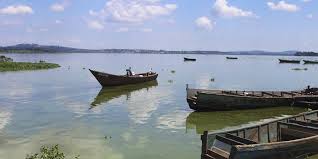
Govenrment has attributed the foul smell recently reported along parts of Lake Victoria to persistent algal blooms caused by rising pollution levels in the lake’s bays, particularly Inner Murchison Bay.
In a statement on Tuesday, the Ministry of water said “The foul smell is a result of excessive algal growth driven by high pollution levels in the bays.”
It said that Inner Murchison Bay has been the most affected.
The Ministry noted that Lake Victoria and its basin support more than 45 million people as a source of drinking water, transport, hydropower, biodiversity, climate regulation and trade.
According to the Ministry, Inner Murchison Bay is among the most heavily utilised sections of the lake in Uganda.
“The bay is shallow, less than 10 metres deep, and sheltered from the open lake, which makes it especially vulnerable to pollution,” officials explained. Other bays facing similar challenges include Kitubulu and Nakiwogo in Entebbe, as well as Napoleon Gulf in Jinja.
The Ministry said the affected bays receive heavy pollution loads from surrounding catchment areas. “The pollution comes from surface runoff carrying silt, human and plastic waste, municipal wastewater from nearby suburbs, industrial effluent, and runoff from agricultural fields,” it said.
The situation, the Ministry added, has been worsened by wetland degradation.
“Wetlands previously played a critical role in filtering nutrients and trapping suspended organic matter before water entered the open lake.”
To track changes in water quality, the Ministry said it operates a Water Quality Monitoring Network wit 23 monitoring stations in Inner Murchison Bay and 10 in Entebbe Bay, with samples collected quarterly to guide policy decisions and remedial actions.
It said data from the monitoring network shows a persistent increase in nutrient concentrations, particularly nitrogen and phosphorus.
“These nutrients are essential for algal growth, and their increasing levels have led to frequent algal blooms in the bays,” the Ministry noted.
It added that “the recent dry season and high temperatures intensified the blooms when water mixing occurred.”
The Ministry explained that the unpleasant odour arises when algae die and decompose. “During decomposition, algae consume oxygen and release gases such as hydrogen sulphide and ammonia, which cause the foul smell,” it said.
Officials warned that “reduced oxygen levels in the water are harmful to aquatic life and can lead to fish kills.”
The decomposing algae, the Ministry added, also release nutrients back into the lake, “creating a vicious cycle of recurring algal growth.”
The stench has been most pronounced around Inner Murchison Bay in Luzira and parts of Entebbe.
According to the ministry, several interventions are already underway to address the problem.
“We are restoring degraded wetlands, enforcing the 200-metre buffer zone around the lake, strengthening water quality monitoring, and scaling up enforcement of effluent discharge standards,” the Ministry said.
It added that industries are being supported to adopt cleaner production techniques and that public awareness campaigns on lake protection are ongoing.
However, the Ministry acknowledged that the efforts need to be intensified.
“Solid waste management around the lake and its catchment needs to be prioritised to reduce nutrient inflows,” it said, calling for “stronger enforcement of environmental and public health regulations by urban authorities.”
The Ministry also stressed that “environmentally friendly land-use and agricultural practices must be promoted, and more industries must adopt cleaner production methods.”
The Ministry warned that algal blooms will persist unless pollution entering the lake is significantly reduced.