










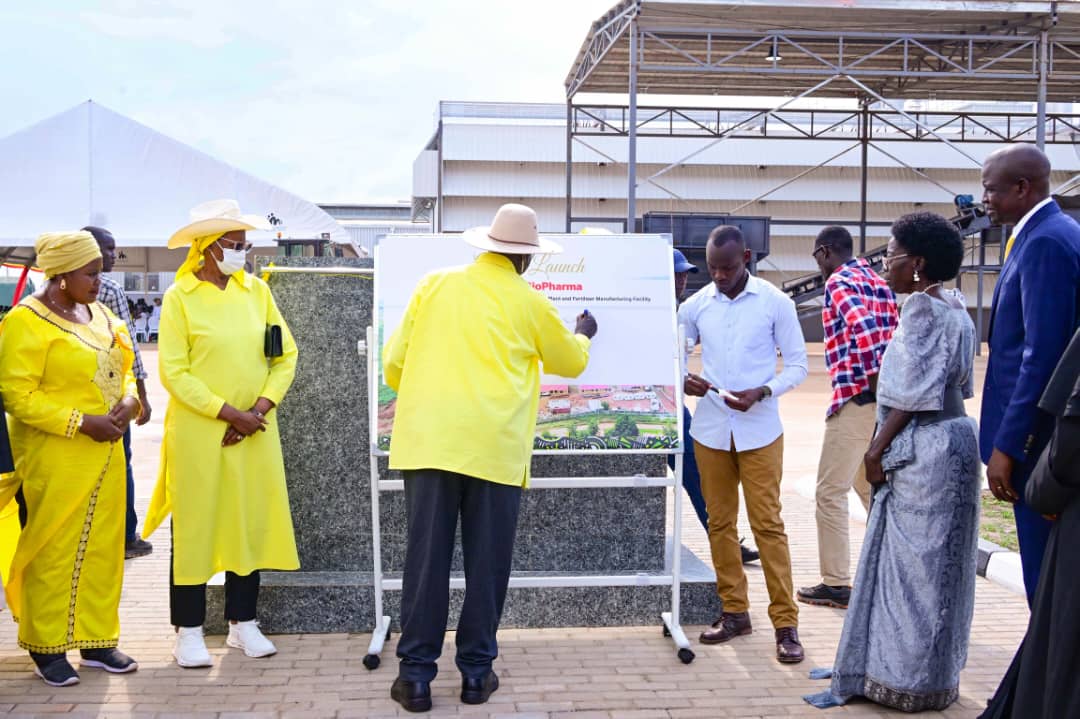
President Museveni on Thursday commissioned the Dei Biopharma Cassava Starch Manufacturing Plant and launched the Advanced Agro-Processing and Biotech Park in Namasagali, Kamuli District — a landmark investment expected to position Uganda as a regional leader in pharmaceutical manufacturing and agro-industrial innovation.
The $50 million starch facility, developed by Ugandan scientist Dr. Matthias Magoola, marks a major step toward reducing Uganda’s dependence on imported pharmaceutical inputs. The factory will produce starch, glucose, maltose and a range of industrial sugars essential for food and drug manufacturing. It requires 500 metric tonnes of cassava daily and is projected to extract more than 100 derivatives from cassava, maize and potatoes.
This plant is the first phase of a broader $10 billion, 10-year investment plan to establish a fully integrated biotech and agro-processing hub in Busoga. The larger park will house facilities for active pharmaceutical ingredients (APIs), excipients, vaccines, organic fertiliser production and a 1,000-bed specialist hospital for sickle cell, cancer and rare genetic disorders.
Speaking at the event, President Museveni praised Dr. Magoola’s resilience and ingenuity, recalling how he first met the young scientist years ago.
“I appreciate his innovation and I will continue supporting him,” Museveni said, urging Magoola to ignore critics who doubted his work. “Africans don’t like innovation; they are used to sleeping. People thought I was mad when I started fighting. We must support our innovators.”
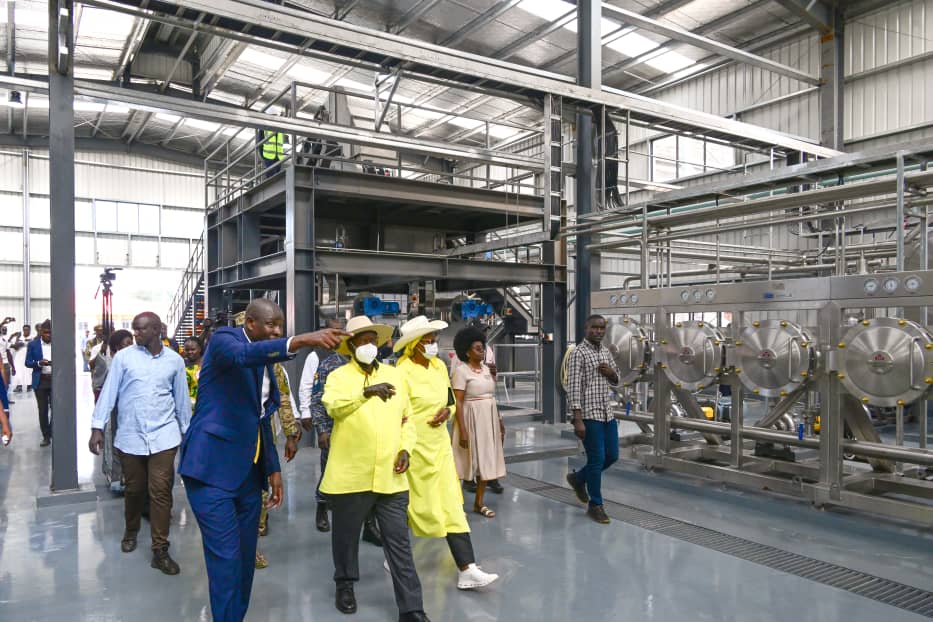
The President emphasised that industrialisation remains central to Uganda’s economic agenda. “Industries employ 1.3 million people compared to only 480,000 civil servants,” he noted, reaffirming the government’s commitment to supporting value addition projects that boost jobs, exports and local production.
Dr. Magoola highlighted the urgent need to locally manufacture pharmaceutical ingredients, noting that Africa imports up to 85 percent of essential medicines while nearly 99 percent of excipients used in tablet and capsule production are imported. “This drives up production costs and makes African medicines uncompetitive,” he said. “Our aim is to make quality medicines affordable for Ugandans and Africans.”
The Namasagali site was strategically chosen for its proximity to major cassava-growing regions — Busoga, Bukedi, Teso, Lango and parts of the Democratic Republic of Congo. Dei Biopharma has already registered more than 3,000 farmers and distributed high-yield Nilocus-1 cassava varieties. According to Magoola, cassava farmers stand to earn nearly three times more than sugarcane farmers due to the crop’s short maturity period and higher returns.
The investment is expected to transform the livelihoods of farmers in eastern and northern Uganda, providing a stable, high-volume cassava market and reducing the economic vulnerability associated with sugarcane monoculture.
Beyond starch production, the facility is equipped to generate glucose, malt sugars, fructose and specialised pharmaceutical-grade derivatives. Dei Biopharma plans to manufacture more than 100 products, including sorbitol, mannitol, dextrose, vitamin C inputs and intermediates required for tablet and vaccine production. Once approved by the U.S. Food and Drug Administration, the company will supply African and Global South markets.
Later in the day, President Museveni also commissioned the Dei Group’s Organic Fertiliser Plant in Nansololo, further expanding the industrial ecosystem within the 5,000-acre biotech and agro-processing park.
A flagship element of the $10 billion vision is the proposed 1,000-bed specialist hospital that will pioneer advanced gene and cell therapies for sickle cell disease, cancers and rare genetic disorders. Dr. Magoola explained that by leveraging Uganda’s status under the WTO TRIPS provisions for least developed countries, Dei Biopharma will manufacture approved therapies locally, drastically cutting treatment costs. While international gene therapies like Lyfgenia and Casgevy cost $2 million to $3 million per dose, the company aims to reduce the cost of a complete cure to between $10,000 and $50,000.
“Sickle cell affects millions of Africans, yet less than one percent get proper treatment,” Magoola said, noting Uganda’s ranking among the world’s highest-burden countries. “Our mission is both scientific and humanitarian.”
With more than 100 patent applications filed across biotech, pharmaceuticals and advanced materials, Dei Biopharma plans to list on the Uganda Securities Exchange as production scales across its 30 manufacturing lines.
“This is not just for Uganda — it is for Africa,” Magoola said. “For the first time, we will produce our own excipients, APIs and vaccines to global standards.”
The starch plant commissioning represents a pivotal milestone in Uganda’s industrial journey — one that signals new opportunities for farmers, new capabilities for the country’s pharmaceutical sector, and renewed confidence in homegrown scientific innovation.