










SchoolPay, NPEIA-UG Sign Deal to Digitise Private Education Sector
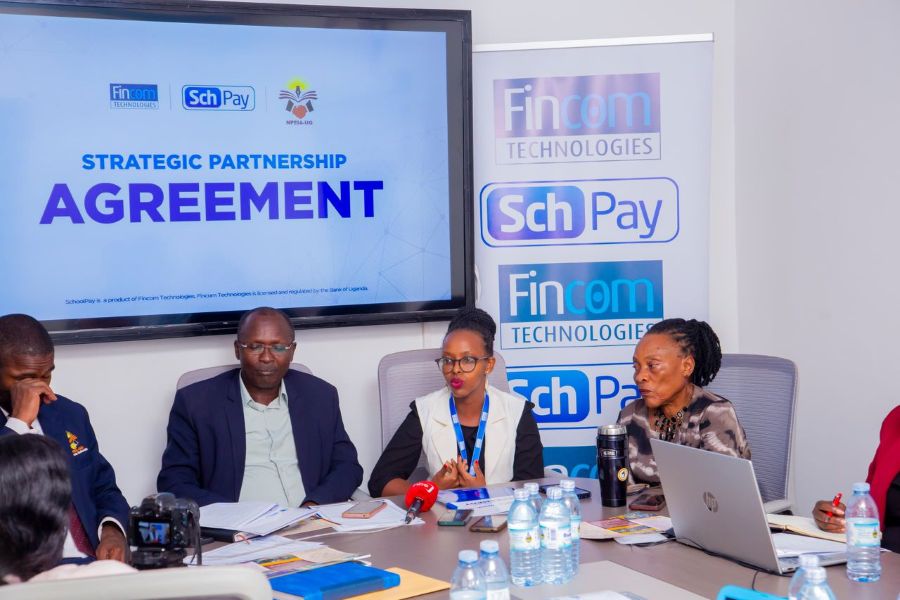
SchoolPay, an education fintech platform powered by Fincom Technologies, has signed a partnership with the National Private Educational Institutions Association-Uganda (NPEIA-UG) aimed at strengthening digital transformation, financial transparency, and operational efficiency in Uganda’s private education sector.
Officials from both institutions said the collaboration is intended to equip private schools with advanced financial management tools to address long-standing challenges in fees collection, accountability, and administration.
Charity Atukwatsa, Chief Executive Officer of Fincom Technologies, said the partnership aligns with the company’s broader goal of supporting the entire education ecosystem.
“We introduced the SchoolPay platform to improve transparency by enabling schools to track payments directly into their accounts. We have simplified how parents pay school fees and enhanced accountability within institutions,” Atukwatsa said.
She noted that integrating SchoolPay’s technology with NPEIA-UG’s nationwide network of private schools will widen access to secure and structured digital payment systems.
“This partnership enables us to reach more schools collectively. Previously, we worked with institutions individually, but now we can engage them at scale through the association,” she added.
SchoolPay currently serves more than 20,100 schools and approximately 8.95 million students across Africa, facilitating transactions worth over $3 billion annually. In Uganda alone, the platform processes more than Shs3 trillion in transactions each year, according to company officials.
Atukwatsa said the partnership will help schools reduce fees defaulting through structured and transparent collection systems that minimize arrears and improve revenue predictability.
She added that the platform supports flexible payment arrangements for parents, a move expected to reduce learner dropout rates.
“We are also introducing responsible school financing mechanisms that enhance liquidity, stabilize school operations, and support timely payment of staff and service providers,” she said.
Beyond school fees management, SchoolPay also provides School Information Management Systems (SIMS), including modules for academic management, payroll, staff administration, data reporting, and parent communication.
Alex John Sseruwu, Secretary General of NPEIA-UG, welcomed the partnership, describing it as timely for private institutions seeking sustainable financial and administrative solutions.
“In the past, learners endured long queues at banks, and internet disruptions often forced parents to carry cash to schools, which posed security risks. SchoolPay has made the process more convenient and secure,” Sseruwu said.
He noted that digital systems help schools monitor payments in real time, reduce defaulting, improve budgeting accuracy, and enhance financial planning.
While some member schools have already adopted the platform, Sseruwu said the partnership will encourage wider onboarding across the association’s network.
Didas Orikiriza, Executive Director of NPEIA-UG, said the shift to digital systems strengthens accountability not only in finance but also in academic management, inventory tracking, and human resource administration.
“Private schools depend primarily on tuition fees. Real-time digital payments support effective planning. For many parents, especially farmers, it also allows them to pay during peak harvest seasons and avoid future financial strain,” Orikiriza said.